
Equitable Distribution: A Nassau & Suffolk County Spouse’s Complete Guide to Fair Asset Division

If you’re heading into a divorce on Long Island, you’ve probably heard the term “equitable distribution” — and wondered what it means for your house, retirement account, or the business you built together. The short answer: New York doesn’t split marital property 50/50. Courts divide it based on what’s fair, weighing specific factors, which is why this guide breaks down what counts as marital property and how to protect your share in Nassau and Suffolk County.
What Does Equitable Distribution Mean in New York?
Judges look at the whole picture — each spouse’s income, contributions, and future needs — and divide marital property in a way that’s fair, even if that means one spouse receives more than the other.
This rule comes from New York’s Domestic Relations Law §236(B). The law treats marriage as an economic partnership. Both spouses are presumed to have contributed to the marriage’s success, whether through income, raising children, managing the household, or supporting the other spouse’s career.
This is especially true on Long Island, where heating oil tanks are common in older homes across Nassau and Suffolk County, and soil and groundwater contamination claims can get complicated quickly. The more organized your paper trail, the stronger your position when negotiating.
Marital Property vs. Separate Property: Why the Difference Matters
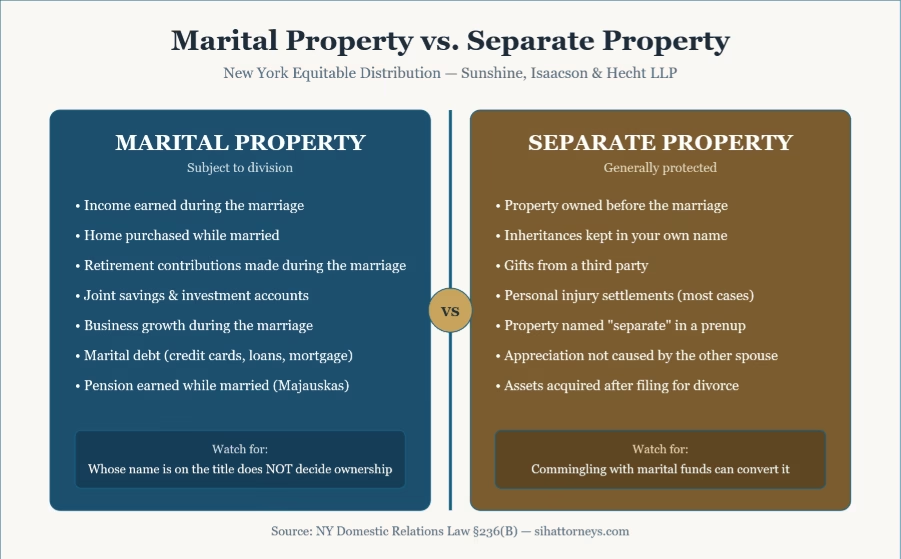
Before a court can divide anything, it has to figure out what’s actually “on the table.” Property in a New York divorce falls into one of two categories.
| Marital Property | Separate Property |
Definition | Acquired by either spouse during the marriage | Owned before the marriage, or acquired by gift/inheritance |
Examples | Home purchased after the wedding, joint savings, income earned during the marriage, retirement contributions made while married | A house owned before marriage, an inheritance kept in your own name, a personal injury settlement (in most cases) |
Subject to division? | Yes | Generally no, unless it was mixed with marital funds |
Common pitfall | Assuming whoever’s name is on the title automatically keeps the asset | Depositing inheritance money into a joint account, which can convert it to marital property |
Separate property can lose its protection if it’s “commingled.” For example, if you inherit money and deposit it into a joint checking account you both use, a court may treat some or all of it as marital property. Keeping separate funds in your own name, in your own account, is one of the simplest ways to protect them.
The Factors a Nassau or Suffolk Judge Will Weigh
If you and your spouse can’t agree on a settlement, a judge will decide for you. Under DRL §236(B)(5)(d), the court considers a long list of circumstances, including:
- The income and property each spouse had when they married and when they filed for divorce
- The length of the marriage and the age and health of both spouses
- Each spouse’s need to occupy the marital home (especially when children are involved)
- Loss of inheritance or pension rights as a result of the divorce
- Any award of spousal maintenance
- Each spouse’s direct or indirect contributions to the marriage, including homemaking and child-rearing
- The difficulty of valuing certain assets, like a closely held business
- Whether either spouse wasted or hid marital assets during the divorce
- The tax consequences each spouse will face
- Any other factor the court finds “just and proper”
This last factor gives judges real flexibility — which is exactly why the way your case is presented matters so much. Two spouses with identical assets can walk away with very different outcomes depending on how well their side of the story is documented and argued.
Assets That Get Disputed Most Often on Long Island
Some types of property come up again and again in Nassau and Suffolk County divorces, and each comes with its own wrinkles.
The marital home.
If you can’t agree on what to do with the house, a judge may award it to one spouse and offset the other spouse’s share with different assets. If there isn’t enough to balance it out, the court can order the home sold and the proceeds split.
Pensions and retirement accounts.
Thanks to a landmark 1985 case, Majauskas v. Majauskas, courts treat the portion of a pension earned during the marriage as marital property — even if it won’t be paid out for years.
Businesses and professional practices.
Valuing a business is rarely simple. Courts often rely on financial experts to determine fair market value, and they’ll also weigh whether the non-owner spouse contributed to the business’s growth.
Marital debt.
Equitable distribution isn’t just about who gets the assets — debt gets divided too. Credit card balances, loans, and mortgages accumulated during the marriage are typically considered shared obligations, even if only one spouse’s name is on the account.
Hidden assets.
New York law requires full financial disclosure from both spouses. If one spouse suspects the other is hiding bank accounts or undervaluing property, an attorney can use subpoenas, forensic accountants, and discovery tools to uncover it.
Separation and Postnuptial Agreements Can Change the Outcome
If you and your spouse signed a prenuptial or postnuptial agreement, it may override the standard equitable distribution rules entirely — as long as it was signed voluntarily, with full financial disclosure, and isn’t grossly unfair. Courts in Nassau and Suffolk County generally honour these agreements, which is one reason it’s worth having a divorce attorney review yours closely before assuming you already know how your assets will be split.
If your situation involves significant wealth, a business, or multiple properties, it’s worth reading our related guide on protecting wealth in a high-asset Nassau County divorce for additional strategies.
How an Attorney Helps You Get a Fair Share
Equitable distribution gives judges discretion — and discretion means preparation matters. A Nassau or Suffolk County divorce attorney can help by:
- Identifying and documenting all marital and separate property early
- Bringing in appraisers or forensic accountants to value homes, businesses, and pensions accurately
- Spotting hidden or undervalued assets before they slip through the cracks
- Negotiating a settlement that avoids the cost and stress of trial
- Presenting your contributions to the marriage — financial and otherwise — clearly to the court
If negotiation feels more realistic for your situation than litigation, our overview of how mediation shapes fair outcomes in family law disputes walks through that alternative in more detail.
Get Help Protecting Your Share
Equitable distribution gives New York courts a lot of flexibility — which means how you present your case can directly affect your financial future. If you’re facing a divorce in Nassau or Suffolk County, the team at Sunshine, Isaacson & Hecht LLP can help you understand your rights and build a strategy for a fair outcome. Contact us today for a free case evaluation or call (516) 352-2100.
Attorney Advertising. This article is for informational purposes only and does not constitute legal advice. Every divorce case is different — consult a licensed New York attorney about your specific situation.
FAQ
Does equitable distribution mean my assets will be split 50/50?
No. New York judges divide marital property based on what’s fair given your specific circumstances, not an automatic equal split. Depending on the factors involved, one spouse may receive more or less than half. Equitable distribution does not mean “equal distribution”.
What counts as "marital property" in New York?
Generally, any income, property, or debt acquired by either spouse from the date of marriage until the date a divorce action is filed. This includes salaries, retirement contributions, real estate, and most assets purchased during the marriage, regardless of whose name is on the title.
Is my inheritance protected from equitable distribution?
Usually, yes — inheritances are treated as separate property. However, if you deposit inherited funds into a joint account or use them for shared expenses, a court may consider some or all of it commingled and subject to division.
Who keeps the house after a divorce in Nassau or Suffolk County?
It depends. A judge may award the home to one spouse and balance the division with other assets, order the home sold with proceeds split, or approve whatever arrangement you and your spouse negotiate in a settlement.
Is debt divided the same way as assets?
Yes. Marital debt, such as credit cards, loans, or a mortgage taken on during the marriage, is generally considered a shared obligation and divided as part of the overall settlement, even if it’s only in one spouse’s name.
Are retirement accounts and pensions divided in a New York divorce?
New York requires full financial disclosure during divorce. If you suspect your spouse is hiding money or property, your attorney can use subpoenas, depositions, and forensic accountants to uncover undisclosed assets, and a court may penalize a spouse who concealed them.
What happens if my spouse is hiding assets?
New York requires full financial disclosure during divorce. If you suspect your spouse is hiding money or property, your attorney can use subpoenas, depositions, and forensic accountants to uncover undisclosed assets, and a court may penalize a spouse who concealed them.
Does a prenuptial agreement override equitable distribution?
It can. A valid prenuptial or postnuptial agreement that was signed voluntarily, with full disclosure, generally controls how property is divided instead of the standard statutory factors.
How is a family business divided in a divorce?
Businesses are usually valued by a financial expert, and the court considers both spouses’ contributions to its growth. The business may be awarded to the operating spouse, with the other spouse compensated through other assets or a structured payment.
Do I need a lawyer if my spouse and I already agree on how to split things?
It’s still wise to have an attorney review any agreement before signing. Even amicable divorces can overlook tax consequences, hidden valuation issues, or future financial risks that a written settlement should account for.