
High-Asset Divorce in Nassau County: How to Protect Wealth

A high-asset divorce in Nassau County can put millions at risk if not handled strategically. When businesses, investments, and long-term assets are involved, even small mistakes can have lasting financial consequences.
Courts are increasingly considering financial transparency and asset valuation. Early knowledge of how to safeguard your wealth can make a great difference in your results.
Oil spills cause more than just cleanup costs for many Nassau and Suffolk County homeowners. Repairs, temporary housing, property value issues, and insurance disputes can all be a part of the situation.
Oil spill victims in New York may have several avenues for financial compensation related to the contamination.
What Defines a High-Asset Divorce?
A high-asset divorce usually involves significant wealth, but the complexity of the assets is what makes these cases challenging. Privately owned businesses, multiple real estate holdings, investment portfolios, and executive compensation plans are often handled differently than assets that can be easily valued and divided.
These cases require more extensive financial analysis than standard divorces. The ownership, valuation, and classification of assets may all become disputed issues. Although an asset may appear straightforward, it can become more complicated when it has been shared or commingled during the marriage. Because these matters often involve complex legal and financial considerations, working with experienced New York divorce and family attorneys can help individuals better understand their rights and navigate the divorce process more effectively.
Understanding Equitable Distribution in New York
New York adheres to equitable distribution, which implies that the assets are divided fairly, but not equally. This principle in a high-asset divorce in Nassau County permits flexibility but also creates uncertainty.
Marital vs Separate Property
Marital property consists of property that was acquired during the marriage, whereas separate property consists of property that was acquired prior to the marriage, inheritances, and gifts.
Nonetheless, separate property may lose its protection in case it is mixed with marital funds. To illustrate, when inherited money is used to buy a property that is jointly owned, it may turn into a marital property.
This distinction is crucial and requires clear financial records to be upheld.
How Courts Evaluate Fairness
The courts take into consideration a number of factors such as the length of the marriage, financial and non-financial contributions, and the earning capacity of each spouse in the future. These same considerations can also affect issues related to spousal support in high-net-worth divorce cases.
Courts also consider lifestyle, financial complexity, and long-term sustainability in high-net-worth cases. Since judges have discretion, results may vary depending on how the case is presented.
Key Financial Risks in High-Asset Divorce
High-net-worth divorces are risky and can have a considerable impact on long-term wealth.
- The interests of the business can be underestimated or contested.
- Separate property can be reclassified as a result of commingling.
- Complex or hidden assets can slow down the process.
- The tax implications can decrease the real asset value.
- Emotional judgments may lead to undesirable settlements.
Early knowledge of these risks enables improved strategic planning.
Hidden Assets and Financial Disclosure Challenges
Financial disclosure is an important part of any divorce; however, in high-asset cases, it becomes much more complicated. The two parties should give a full disclosure of their finances, but the asset structures can be complex and thus difficult to disclose.
Examples of hidden assets are offshore accounts, deferred compensation, or investments held through layered entities. In other instances, the assets are not deliberately concealed but rather are hard to trace because they are complex.
The nondisclosure of assets may have severe legal implications, such as monetary fines or adverse court rulings. Courts expect financial transparency, and any effort to hide the financial information can be detrimental to credibility.
That is why thorough financial research is frequently required in a high-asset divorce in Nassau County.
- Photographs And Videos
- Environmental Reports
- Remediation Invoices
- Repair Estimates
- Receipts For Hotel and Relocation, And
- Insurance Correspondence
- And Medical Records
The more information that homeowners can keep early in the process, the easier it may become to support compensation claims later.
Valuation Disputes: Why Asset Worth is Often Contested
One of the most disputed issues of high-asset divorce is the determination of the value of assets. The results of different valuation methods may vary significantly, particularly when it comes to businesses or long-term investments.
There might be disagreements among experts regarding the emphasis on current value or potential of future earnings. Such variations may lead to significant financial disparities between rival appraisals.
Conflicts do not only occur in business. It can be real estate, investment portfolios, and luxury assets that can all be the subject of differing opinions. Expert testimony is used to decide on these disputes but the verdict is usually determined by the quality of evidence provided.
Proper valuation is a necessity since it directly influences the way of dividing assets.
How to Protect Wealth in a High-Asset Divorce

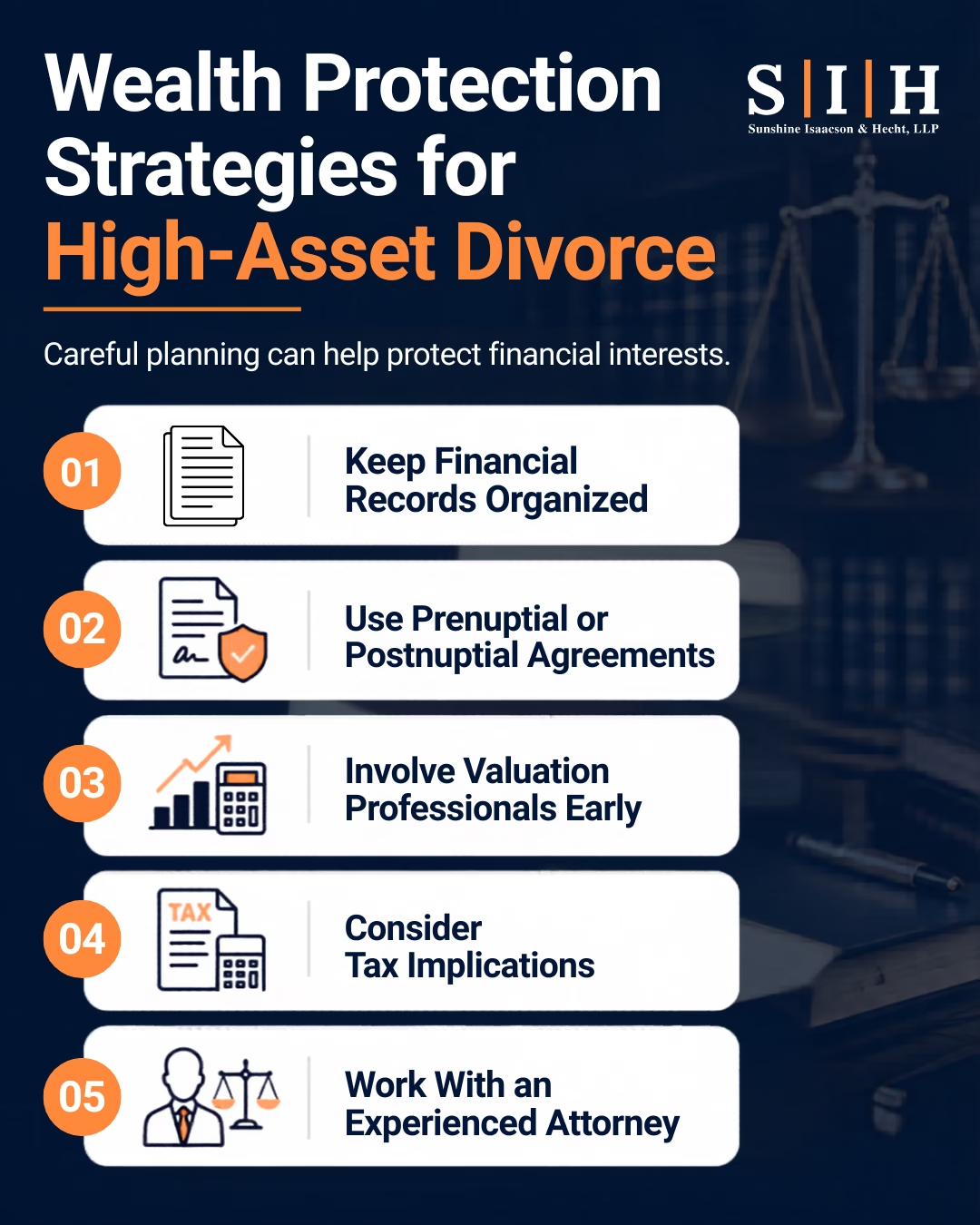
Protecting wealth in a high-asset divorce requires careful planning and informed decision-making. The following strategies can help reduce financial risk and protect valuable assets:
- Maintain Accurate Financial Records
Keep organized records of bank accounts, investments, properties, and business interests to support ownership claims and asset classification.
- Use Prenuptial or Postnuptial Agreements
These agreements can help define how assets should be handled and reduce disputes during divorce proceedings.
- Obtain Professional Asset Valuations Early
Early valuations of businesses, real estate, and investments can provide a clearer picture of asset worth and support fair negotiations.
- Consider Tax Consequences
Evaluate potential tax liabilities before agreeing to any settlement to understand the true value of assets being divided.
- Protect Separate Property
Avoid mixing separate assets with marital funds whenever possible, and maintain documentation to preserve their status.
- Work with Experienced Professionals
High-net-worth divorce attorneys and financial experts can help identify risks, protect assets, and guide strategic decisions throughout the process.
These measures can be used to reinforce your stand and minimize financial risk.

The Role of Forensic Accounting in High-Asset Divorce

Forensic accounting has gained a lot of significance in the high-asset divorce cases. These are the professionals who specialize in the analysis of financial data in order to identify discrepancies, trace the origin of assets and ensure full disclosure.
In complicated cases, forensic accountants can determine concealed sources of income, assess business documentation, or examine assertions regarding the possession of assets. Their work tends to give the clarity to solve disputes.
In addition to the discovery of hidden assets, forensic accounting also aids in proper valuation and enhances legal arguments. This makes it an important part of most high-net-worth divorce plans.
Business Ownership and Complex Asset Division
Ownership of a business is usually one of the most complex aspects of a high-asset divorce. Although a business might have been started prior to marriage, the development of the business during the marriage period may be divided.
Professional valuations are used by the courts to establish fair market value. This will involve the analysis of financial performance, assets and future earning potential.
Dividing a business is rarely simple. In most instances, one of the spouses can purchase out the interest of the other spouse or the value can be set off against other assets. The aim is to ensure that there is fairness without compromising the viability of the business.
Tax Implications You Cannot Ignore
The actual value of a divorce settlement can be greatly affected by tax consequences. The assets that seem to be valuable on paper could be accompanied by tax liabilities.
As an illustration, the sale of investments can result in capital gains taxes, and retirement accounts should be managed with caution to avoid taxation. Tax consequences can also arise in real estate transactions and support arrangements.
These factors should not be overlooked as they may result in unforeseen financial losses. With proper planning, the division of assets will reflect the real value as opposed to the nominal values.
How Nassau County Courts Handle High-Net-Worth Divorce Cases?
Courts in Nassau County have a systematic procedure in dealing with high-asset divorces. They start by recognizing and categorizing all assets and then proceed to value them with the help of experts.
After setting values, the principles of fair distribution are used to share the assets equally. In complex cases, courts may use creative solutions such as deferred payments or asset offsets.
Financial transparency, documentation, and strong legal arguments play a major role in the outcome.
Conclusion
The high-asset divorce in Nassau County is a complicated process that needs to be carefully planned and informed decision-making. Since there is a lot of wealth involved, every detail counts, including how the assets will be classified, how they will be valued and how they will be negotiated.
Understanding the legal system, identifying potential risks, and working with experienced professionals can help protect your assets and support informed decision-making throughout a high-asset divorce. In some cases, mediation may provide an opportunity to resolve complex financial issues and negotiate asset division more efficiently.
FAQ
What is a high-asset divorce in Nassau County?
In general, the cases that are characterized by substantial assets (which are often over 1 million) and complexity are the defining factor.
Is everything split 50/50?
No. New York is an equitable not equal distribution.
Is it possible to safeguard pre-marital assets?
Yes, provided you can distinctly demonstrate that they are independent and not mixed up.
What is the division of businesses?
By valuation, which is then followed by buyouts, sales or asset offsets.
What is the case when assets are concealed?
Courts can provide penalties and redistribute in favor of the other spouse.
Should I have a forensic accountant?
Yes, in most high-asset cases, they assist in making sure accuracy and transparency.