
Tortious Interference with Business in Nassau & Suffolk County

Building a business on Long Island takes years of relationships with clients, vendors, and referral sources. When a competitor or a former employee deliberately damages those relationships, that isn’t fair competition. It’s a legal wrong, and New York law gives business owners in Nassau and Suffolk County a way to fight back.
This is where tortious interference with business comes in. It’s one of the most useful, and most misunderstood, business torts available to companies across Long Island. Understanding how it works, and where the legal line actually sits, is the first step toward protecting what you’ve built.
What Is a Tortious Interference with Business?
Tortious interference with business is a claim that lets a company hold a third party accountable when that party intentionally disrupts a contract or a business relationship. New York recognizes two related but distinct causes of action:
- Tortious interference with an existing contract – when someone knowingly causes another party to breach a valid, existing agreement with you.
- Tortious interference with prospective business relations – when no contract exists yet, but someone uses improper means to stop a deal or relationship that was reasonably likely to happen.
The distinction matters. New York protects an existing, signed contract more strongly than a relationship that’s still developing, and the proof required scales accordingly. A rival who lures a client in mid-contract faces an easier standard for you to meet than one who simply outbids you for work that was never formalized.
When a competitor or Ex-Employee Crosses the Legal Line
Long Island’s business community is close-knit, which means many interference disputes involve people who know each other well: former partners, departing employees, or longtime referral sources. Competition on its own is always legal. It’s when a rival or former employee deliberately damages your business relationships that the conduct crosses from fair play into a tortious interference claim.
Common Situations in Nassau and Suffolk County
Typical scenarios include:
Departing employees
who take client lists, solicit customers before their last day, or violate a non-compete or non-solicitation agreement.
Competitors
who spread false or misleading claims about your products or services to win over clients.
Vendors or business partners
who pressure a third party into cancelling or breaching a contract with you.
Former partners
who, after a falling-out, disparage their old business and quietly steal its clients.
If any of this sounds familiar, it may overlap with a breach of contract claim or, in the case of a business relationship that’s fully broken down, a partnership or LLC dispute.
What You Need to Prove
Courts don’t let every lost customer or missed opportunity become a lawsuit. New York sets out a real bar for a tortious interference claim. Generally, you need to show:
- A valid contract, or a reasonable expectation of a business relationship, existed between you and a third party.
- The defendant knew about it – actual knowledge of the contract or relationship, not just a vague awareness that you did business with someone.
- The defendant intentionally and improperly interfered – through conduct like fraud, misrepresentation, threats, or misuse of confidential information.
- The interference actually caused a breach or termination of the relationship.
- You suffered quantifiable damages as a result.
Claims involving an existing contract are somewhat easier to prove than claims involving a prospective relationship, because New York requires “wrongful means” for the latter. Ordinary competition, even aggressive competition, generally isn’t enough on its own. There has to be something improper: lying to your client, using stolen data, or threatening a third party into walking away.
Damages and Remedies

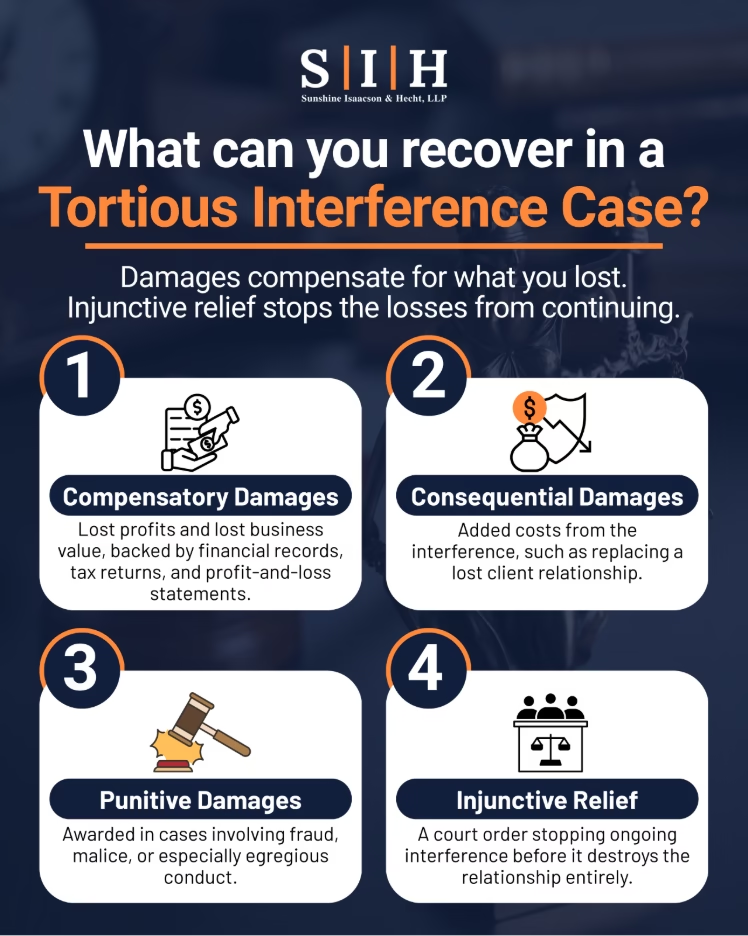
If you succeed on a tortious interference claim, New York allows you to recover:
- Compensatory damages for lost profits and lost business value, supported by financial records, tax returns, and profit-and-loss statements.
- Consequential damages, such as the added cost of replacing a lost client relationship.
- Punitive damages, in cases involving fraud, malice, or particularly egregious conduct.
- Injunctive relief, which can stop an ongoing campaign of interference before it destroys what’s left of the relationship.
Injunctive relief is often the most valuable remedy in the moment. If a former employee is actively soliciting your remaining clients with your own pricing data, waiting years for a damage verdict won’t save those accounts. A request for an injunction, paired with a damages claim, is frequently the stronger overall strategy.
Businesses that suspect the interference also involved theft of confidential data, such as customer lists or pricing sheets, may have grounds for related claims. This kind of overlap is common in the legal mistakes that lead to business owner lawsuits we see across Nassau and Suffolk County.

Defenses You Should Expect
Defendants in these cases rarely concede. The most common defenses include:
- Economic justification – arguing the defendant had a legitimate financial stake in the outcome, such as a lender protecting collateral.
- No actual breach occurred – particularly common when the underlying agreement was terminable at will.
- Lack of knowledge of the contract or relationship.
- Fair competition – the argument that the defendant simply competed better, without any wrongful conduct.
The strength of your case usually comes down to specificity. Vague claims that a competitor “took our clients” rarely survives early motions. Detailed evidence of what the person actually did, and how they knew about your contract or relationship, is what separates a viable claim from a dismissed one.
Protecting Your Business Now
If you suspect a competitor or former employee has crossed the line from competition into interference, act early:
- Document every relevant communication, contract, and lost account.
- Preserve evidence of the other party’s knowledge and intent, including emails, texts, or recruiter messages.
- Track your financial losses as they happen, not months later.
- Consult an attorney before confronting the other party, so you don’t compromise your claim.
New York’s statute of limitations for tortious interference is three years, so there’s time to build a case carefully, but that doesn’t mean you should wait. Evidence disappears, memories fade, and ongoing interference compounds your losses the longer it continues.
Talk to a Long Island Commercial Litigation Attorney
Tortious interference cases move quickly from a business dispute to serious litigation, and they require a lawyer who understands both the legal standard and the local Nassau and Suffolk courts. The commercial litigation attorneys at SIH Attorneys represent business owners across Long Island in disputes involving stolen clients, broken contracts, and competitors who overstep the legal line.
If your business has been damaged by a competitor, former employee, or partner, contact SIH Attorneys for a free consultation to discuss your options.
FAQ
What is the difference between tortious interference with contract and tortious interference with prospective business relations?
Interference with an existing contract involves a signed, valid agreement that someone caused a third party to breach. Interference with prospective business relations applies when no contract existed yet, but someone used wrongful means, such as fraud or threats, to stop a deal that was reasonably likely to happen. New York requires more proof for the second type because the law wants to protect legitimate competition.
Can a former employee be sued for taking clients with them?
Yes, if the former employee used confidential information like customer lists or pricing data, violated a valid non-solicitation agreement, or made false statements to lure clients away. Simply changing jobs and being good at their new role isn’t enough on its own.
How long do I have to file a tortious interference claim in New York?
The statute of limitations is generally three years from the date of the injury. Waiting too long can weaken your case, since evidence and witness memory degrade over time.
What kind of evidence proves a tortious interference claim?
Financial records showing lost business, communications between the defendant and the third party, internal documents revealing intent, and witness testimony about why the relationship or contract ended are all commonly used to build these claims.
Can I get an injunction to stop ongoing interference while my case is pending?
In many cases, yes. If the interference is causing ongoing, irreparable harm, such as a former employee actively soliciting your remaining clients, a court may grant a preliminary injunction to stop the conduct while the underlying case proceeds.